Showing posts with label Sangke. Show all posts

Sunday, October 2, 2011

Sangke Grasslands


We stopped for lunch, and were served a meal very similar to the last few. By the end of the trip there were some foods I was sure I would never want to eat again, thanks to these tour group style meals, and certainly by the end of the trip all I ever did was pick at my food. After eating we piled into the bus and drove off towards the Sangke grasslands. 


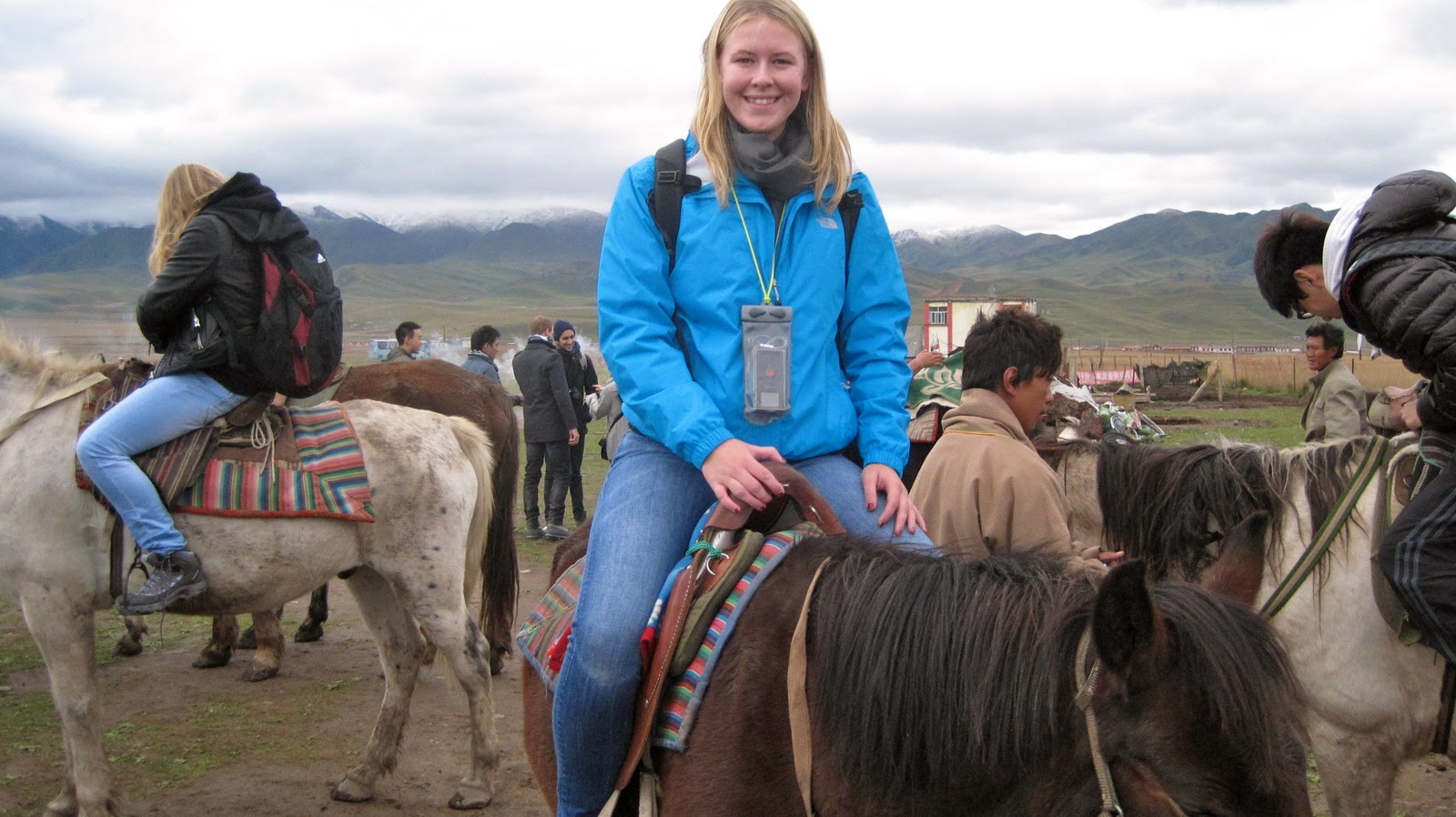
The grassland are approximately 14 km outside of Xiahe where we were staying, and are the home of many Tibetan nomads who live in traditional Tibetan tents and raise yaks, as well as offering horse back riding to tourists. The Sangke grasslands provide spectacular views of the mountains surrounding us, and even offered views of snow-capped peaks. There were only so many horses available at a time for the ride and so we split into two groups. I chose to save horse back riding for last and so spent the first half hour of time in the grasslands with my friends taking in the views. 


The grass, plain a first was actually surprisingly diverse, and dotted with tiny patches of beautifully colored flowers, my favorite ones pictured here. People had fun chasing the baby yaks around and someone found a soccer ball and got a game going. I have to say again that I was thrilled with the mountain air. I felt better than I had since I arrived in Shanghai where I’m constantly suffering from allergy and struggling to breathe through the smoggy air. 

 More Prayer flags, an important part of Tibetan life here. 

Distracted by our game of soccer, it seemed like no time until the other group returned and we got out turn on the horses. We saddled up and rode out. My horse was slower than the rest it seemed to me and for the majority of the ride he simply wandered around, not caring to catch up with the group. I was slightly frustrated but I soon learned to appreciate the calm composure. We ended up turning around to go back the way we came and suddenly I found myself in the front. My horse seemed to take some pleasure in this and took off running, me clutching to the reigns, unsure of how to control the situation. We flew down the trail, startling yak along the way who reared up and purred my horse ever faster onward. Terrified that I wouldn’t be able to stop when the time came I’m sure I was screaming by the time we reached our starting point, at which point my horse calming slowed to a stop and patiently waited for me to descend. Maybe he just wanted to get home? 


I’d received an adrenaline rush from my horse experience and I was ready to have my traditional tent visit now. It was in the same place we had ridden the horses and we all piled into one of the tents to begin the experience. The girls were met with a shock. There was a men’s side and a women’s side. The men’s side was decidedly better with rugs laid out for sitting on and tables for the food to sit on. The girls on the other hand essentially had the floor to sit on. The Americans, who truly believed that all things should be equal, did not take this well, myself included. Why should we have to sit on one side? We managed to be outraged enough that rugs were brought over for our side. The tent was smoky and difficult to breathe in. We were told that the smoke was kept inside to keep out insects for which we were grateful but I think we all would have been happier to avoid choking on smoke.

Eventually they brought out the food, or rather the ingredients for our food. We would be dining on yak butter milk tea, and some sort of cookie dough like substance we were to make from barley flour, milk tea, sugar, and yak butter. The yak butter milk tea was fairly self explanatory. Milk tea in general is currently a huge fad in major Chinese cities and it’s a traditional drink out here in the west. The essential idea is simply tea brewed in milk rather than in water. The only difference between this and yak butter milk tea was the addition of yak butter. The weirder taste test was definitely barley flour mixture. 

The Ingredients. 
 Final product.

You start by adding two large scoops of yak butter to a bowl, then you pour the milk tea mixture over top (it’s not an exact amount), before adding a sizable amount of barley flour and a spoonful of sugar. Actually, you can add sugar to taste, or at least that’s what I did to end up with my cookie dough-like mixture. We kneaded this with our hands for a while until it formed a sort of paste, which you were to eat just like that. Everyone was hesitant but it wasn’t half bad. Although I have to say, it’s not something I’d want to eat every day for my entire life. 


Once we finished mixing our snack and eating it, we all scrambled back on to the bus to head back into Xiahe for some real dinner and some souvenir shopping. Back in the town my friend Slater was discovered my some young Tibetan girls (a few years younger than us) who thought he bore some resemblance to Justin Bieber. The girls were fascinated by us Americans and gave us gifts (I received a bracelet) and they sang us a Justin Bieber song. A few of the girls made plans with us to 
meet for breakfast tomorrow which we happily accepted hoping to learn a few new things about the Tibetan culture. 

 Yum, lamb skewers.

Ew, sheep intestine and heads. 

The dinner, which I was so excited about, turned out to be a disappointment because it was once again the same food. So I made plans with a few others to go find some lamb skewers after dinner for a real meal. The lamb was delicious and I made my way back to the hotel unsure of my plans for the evening. We started off in the hotel, watching the Chinese version of power rangers, laughing as our Chinese fluent friends translated for us, before hunger drove us out again. I wasn’t the only one who had been unsatisfied by the dinner and we found ourselves at the same street food place where I had previously purchased lamb. This time though we had them make us a spicy egg sandwich that they fried in front of us and served piping hot into our awaiting hands. Delicious. 

 With my new skirt.

Then we spent a few hours on the empty streets of Xiahe taking pictures, talking, and enjoying our last night in the town, because we were due to leave the next day. I wore a new skirt I had purchased from a local shop. Brightly colored in the night I released some steam by running down the empty streets of Xiahe. Although I was excited to start our journey to the Desert the next day I was going to miss Xiahe.

Day 1 and the Labrang Monastery


A few days ago I returned from my six day Western exploration of the Gansu province. I have finally recovered enough to begin sharing my experience with you. I learned and experienced so many new things that I never expected, and I certainly won't ever forget. 

We started our journey at Hongqiao Airport, the smaller of the two Shanghai airports, a mere 20-minute drive from my Zhong Shan Park Apartment. We met outside just before 5 AM and drove to the airport where we checked in and passed through security with surprising ease, given the fact that we were traveling with thirty 20 year-olds. After a short wait at the gate filled with talk of what was to come, we boarded the plane and flew off, out of the hazy Shanghai sky and towards the West. 

The plane was a sleepy affair, heads bobbed up and down, fighting gravity and fighting sleep. And before we knew it, 3 hours later, it was time to touch down. We landed at Lanzhou airport, the airport of the capital city of Gansu, about 1 hour outside of the main downtown area, and after collecting our bags we ambled outside to get our first look at the Gansu province. It was dry, and sparse by the airport, with little to hint at what was waiting for us beyond. We boarded our bus, an action that we would take many times throughout the next few days, and that we would learn to love and hate with equal intensity. An hour later we were in Lanzhou proper, eating the first of many “tour group” meals set up by NYU before heading back onto our bus for the remaining 4-hour journey to Xiahe, our first real stop on the trip. 
 Some terraced land.

The landscape became remarkable. Terraced mountains surrounded us as our bus, captained by our amazing driver, expertly navigated the challenges of the sheep laden roads before us. Mosques bloomed on either side of us their peaks and domes, golden and shining and us in brief periods of sun that broke through the cloud cover above. Awed by the scenery around us, the four-hour drive flew by and before I knew it we were entering the Xiahe Tibetan region. 
Prayer flags in Xiahe outside of our hotel.

Real mountains replaced terraced hills, as we entered the foothills of the Himalayan Mountains. Fog rested on the peaks and lush green vegetation covered the land as far as one could see, as cows, sheep, goats, and yaks, grazed on the sides of the road, oblivious to our bus hurtling by. As we pulled up to our garishly colorful hotel, decorated almost inexplicably in an Indian style, complete with elephants, I couldn’t help but be amazed by the place we had just entered. We re-fueled our bodies with some dinner from the hotel’s restaurant and then prepared ourselves for some late-night exploration. Ignoring the rain and the empty streets, we followed our guide Emma down muddy alley-ways, un-lit and slippery thanks to the downpour, in search of the only bar in town to relax after our long day of travel. 
 See what I mean about the elephants?

By the light of our cell phones, we finally managed to reach the bar, a surprisingly large and clean establishment, slightly off the beaten track from the rest of town. Wet and giddy we happily ordered the only drink on their menu, a type of beer made from barley grown in the region, and multiple bowls of microwave popcorn, and settled in for the night. Laughter echoed throughout and the people who owned the bar we obviously amused by the antics of the foreigners. Almost, too soon, it was time to head back to the hotel. This time we knew the way and practically skipped home, full of mountain air, and the knowledge that for the next few days we had no other obligations other than getting to know this new region. 

A wake up call in brisk, Chinese accented English, woke us early the next morning and bade us get ready for the adventures that awaited us that day. Sleepiness fled my eyes almost immediately as I began to prepare for the day ahead. I donned old jeans and sneakers, and my newly purchased winter jacket and stepped out into the chilly morning. 
 The Monastery.


Our first stop of the day was the Labrang Monastery. One of the great monasteries of yellow hat Tibetan Buddhism, the Labrang monastery is the most important monastery outside of Tibet and home to the most monks of any monastery outside of Tibet. The monastery is impressive to look at it and has a rich history. Slipping and sliding down the muddy pathways in the seemingly perpetual rain, we met our guide, a monk who couldn’t be much older than we were who had learned English in his village, and was one of only two monks in the entire monastery who spoke English. He showed us a lot of different rooms filled with giant Buddhas for worship and interesting literature, but what most interested me was our guide himself. 

Brought to the monastery as a young boy as most of the monks were, he was here giving tours because of his incredible English ability, which he had gained at an English school set up in his small home village by an American. Anywhere else in China the ability to speak English would have been an unquestionable one up on everyone around you, but at the monastery it was a completely different story. Being one of only two monks at the monastery who could speak English meant that he was required day in and day out to provide tours for English speaking tourists. Because of these duties he was unable to pursue his studies, which is something that all monks like to do. We couldn’t help but feel sad that we were part of the problem keeping this monk away from what he wanted to do. But it’s a vicious cycle. The monks don’t even want visitors inside the temple but they need money to continue running their affairs so they unwilling let us in, but visitors need tours; so poor monks like our guide are unwilling forced into providing tours. 

 A Yak Butter Sculpture.

Mind reeling with that information I almost didn’t notice that we had stepped into a fascinating room. 20-30 brightly colored sculptures of some kind surrounded us, depicting everything from animals to what looked like local gods. Our guide explained that these were sculptures that artist monks had shaped out of yak butter. I couldn’t believe it. The detail was amazing and the size of the statues was incredible. They destroy these statues after about one year, because of course yak butter starts to get a little gross after a while, and new ones created by the artist monks for next year’s display will replace them. 

After this little tour a few friends and I got distracted by one of the gift shops and ended up losing the group. We weren’t totally put off and made our purchases before setting off to explore on our own. The coolest things that I think I picked up at the temple are a Tibetan bell for my mom, who has a sort of Tibetan style bell at home that she loves, and prayer wheel, which you spin clockwise and that contains rolled up written Tibetan prayers. These are important because many Tibetan Buddhist followers in the area can’t read Tibetan or write it so write prayers of their own. 

We explored the monastery on our own for a while. I was fascinated by the young monks, some as young as 7 or 8 years-old who had been sent here by their parents. Reasons for sending a child here vary. Sometimes it had to do with lack of money to feed their children, and sometimes it’s because the parents are extremely religious. I saw some young monks with yo-yos around their fingers and chasing cats around with sticks, much like you see little boys everywhere doing. Aside from monks we were also met with local Tibetan minority people, the woman easily spotted from their Han counterparts because of their braided hair. 

The very cat they were chasing looking out over the Monastery. 
Distinctive braided hair. 
 Me with some terrified looking Tibetan children! They were afraid of the flash.
 
The views were breath taking and the mountain air was wonderful, cool, and clear. A nice change from hot, muggy, polluted, Shanghai. We hiked along the outside of the Monastery and found the homes where Lamas used to live a long time ago until they moved into the new living quarters that are in the Monastery today. 

 The Lamas' old living arrangements.
The Monastery today is essentially a college where monks study different subjects such as philosophy and medicine. Aside from it’s religious role it has also been involved, albeit unintentionally, in some political aspect of Chinese history. It’s proximity to a large Muslim region has lead to skirmishes between the Buddhists and the Muslims in the past but it’s the more recent political problems that are more troubling. 

For those of you that don’t know, the head of the Tibetan Buddhist religion is the Dalai Lama. The Dalai Lama and the Chinese government don’t exactly get along or see eye to eye. The Chinese government wants to control the naming and selection of the reincarnated Dalai Lama after the current one dies. This is completely unprecedented as it is traditionally other Lamas, specifically the Panchen Lama, the second highest Lama, who choose this reincarnation. The Chinese government had already interfered though, and the Panchen Lama chosen as a young boy by those of the Yellow Hat Buddhist faith disappeared and was replaced with one chosen by the Chinese government. 

The current Dalai Lama has already stated that this practice is absurd and that whomever the Chinese government chooses will not be the true reincarnation because the new Dalai Lama will not be reborn anywhere inside of China, or inside of any country that is not free. 

Tensions in the area had reached new levels in 2008 thanks to other Tibetan riots and protests that had broken out in March of that year. In fact, because it was an area of such political tension, the Monastery and town have only recently re-opened to the public and I was happy to have the chance to see it. 

As our exploration of the Monastery ended rain ceased to fall from the sky, and we took it as a good omen of the rest of our day, which would be spent outside in the Sangke grasslands. As we boarded the bus my mind went back to the recent protests and the pictures of the Dalai Lama I had seen displayed openly inside the Monastery. I hoped that if I ever chose to visit again I would find that the placed was still the same as what I saw today. I found myself looking backward as we drove off toward our next destination.